

- Contributed by
- John Constant
- Location of story:
- Burma
- Background to story:
- Army
- Article ID:
- A7882149
- Contributed on:
- 19 December 2005
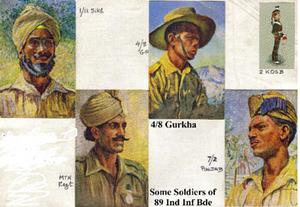
Our soldiers
Chapter 9.
The doctors always had the additional fear that, if the Japs broke through, they would bayonet the wounded to death, as they had done to that same Field Ambulance, in similar circumstances the year before in the Arakan. We also had a little known American unit of men, who exhibited a rather different form of bravery: the Quaker conscientious-objectors, who flew single-engined light aircraft, usually Piper Cubs, right up to the front line to pick up our wounded, by landing on almost any track, however rough. Often with no more than a field dressing, the wounded man would be back in medical hands at the Air-head in no time, for immediate surgery before evacuation by returning supply aircraft to base hospitals. The courage of these non-combatant airmen saved many lives, as well as the innumerable amputations, which would have been necessary, if gangrene had had time to set in, as it had on the long dusty ambulance rides in the Western Desert of Egypt.
There was great jubilation when we took our first prisoner of war. The Japs had invariably committed suicide rather than be captured, however badly wounded, but now the Sikhs brought one in, surely expecting to be tortured, no doubt; he was well treated and sent to Divisional HQ, where the interpreter had been waiting for weeks for just such a moment. The successful attrition continued, as we advanced slowly, knowing that the main body of the Corps had now swept southeast to Meiktila.
I had been away for four and half years, during which I had not seen my wife, and had never seen my daughter, born soon after I had left UK. My time for repatriation came at last, and my successor arrived to take over. Just before I left, I heard a keen staff officer say "There is too much talk about "repat", let's get on with the war!" and he was newly married, with his wife in uniform at Corps HQ !
On my last day, the Anglo-Burmese intelligence platoon arranged for me to be given a Burmese breakfast, the traditional celebration like a buffet of about 100 dishes, from which one helps oneself to as many as possible. The occasion was one of much interest, and they told me that it was the motor car which had, in the years before the Japanese invasion, been the agent effectively alienating the Burmese country folk from the British officials. "In our father's day" they said, "the officials rode through the villages on horseback and chatted to everyone; now they drive through in a cloud of dust, and the people feel they do not care for them."
The next day I left 89 Brigade, but my war was not yet over! I was able to make my way back to Chittagong in a returning supply aircraft, thence to Calcutta and Bombay, where I arrived in good time for the next convoy of troopships to the UK.
Given the choice of waiting in Bombay, which I accepted, I called on the Royal Bombay Yacht Club and was offered a sail in one of their boats; a very pleasant change from Burma. In the bar afterwards, I was talking to a British officer of the Royal Indian Navy, who told me that he had taken over a newly arrived Corvette, and would be accepting her from the dockyard the next morning, when I could join him for the trials --- no special kit required, just my normal uniform. So there I was, at crack of dawn, soon aboard, and out to sea. The ship had come straight from the North Atlantic, with electric radiators in every cabin, but no fans or air-conditioning; and April is hot and damp in those waters. The routine of the trials was interesting, and we were about 20 miles out to sea, when a signal arrived to report a Japanese submarine sighted; we were ordered to go for her. Great excitement for all except the dockyard reps, who like me, had no kit with them. We hunted that sub for a week, before going into Colombo for fuel, and I jumped ship to report my "absence without leave" and made my way, via Supreme HQ South East Asia, Kandy --- what well selected beauties the lady officers were --- to Bombay, and found, as expected, that my convoy to UK had left, and I was to wait for the next one.
The end.
© Copyright of content contributed to this Archive rests with the author. Find out how you can use this.


 Recommended story
 Story with photo