

- Contributed by
- Frank Yates
- People in story:
- Frank Yates, Ken Kenway, Donald Phelps
- Location of story:
- Paris, Luxembourg, Coblenz
- Background to story:
- Army
- Article ID:
- A7406949
- Contributed on:
- 29 November 2005
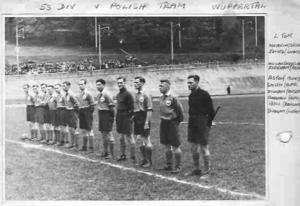
53rd v Poland International at Wupertal
Memories of Frank Yates Chapter 46
Round about this time, Ken and I decided we would have a couple of days in Paris, Taking the Brussels shuttle lorry, we caught a train, arriving at the Gard du Nord, in express time. We took a taxi to the Officers‘ Club in the Rue Faubourg St. Honore, next to, and identical in style with, the British Embassy. The elegant mansion was the previous town house of the Rothschild family. We were relieved to reach the courtyard, embellished with a rococo fountain, after the hair raising taxi ride.
The Officers’ Club was staffed by WVS. Ladies, who showed us the dining room, which served superb lunches and dinners, very cheaply. They also booked us into The Folies Bergeres and The Bal Tabarin to fill in our two evenings, but regretted that they did not provide accommodation.
Ken and I soon found bed only accommodation at the “County Hotel”, a very English sounding place, and, on asking the concierge, very cheap. We found out, that when we put our holdalls in our rooms, that they sported mirrored bed heads and mirrors on the ceilings! Ah well, C’est la Paris! We did the usual tourist spots, generally untouched by the war, as before us, the Germans had been coming on leave since 1940!
Ken and I wandered up stairs to the billiard room where two first class tables were looked after by a marker. Playing a snooker frame with the marker was a captain, who looked familiar. His name was Jaques who had been a troop officer at Topcliffe, years previously. He explained that his LAA. Battery had been disbanded and he had landed the job of War Graves Registration Officer in Paris. He then explained that, as no British soldier had been killed near Paris since the first war, he had plenty of time to play snooker!
In the Louvre, I wondered why the “Mona Lisa” was considered so wonderful, As far as I am concerned, the star of the show was the breathtaking “Winged Victory of Samothrace”, flying out from the top of a flight of marble stairs. We were a bit cheesed off by the many guides wanting to take us on a conducted tour. We were very impressed with the Montmartre district, alive, at night with multicoloured neon signs and illuminated theatres. The Moulin Rouge, predictably, had an enormous set of red neon-lit windmill sails, continuously revolving against the night sky. By day, the steep streets were lined with paintings so typical of this artists’ quarter, the scene of “La Boheme”. Crowning the Montmartre hill rose the fabulous icing sugar dome of the church of “Le Sacre Coeur”.
A visit to the Great Cathedral of Notre Dame, on its island in the Seine, took a large part of the second day, but we never saw anything of the hunchback!
Our theatre visits were very enjoyable, the Folies, a traditional theatre, with a spectacular extravaganza on stage and a secondary show, with jugglers and acrobats etc. in the foyer. The “Tabarin” was a kind of night club, full of very small tables, with little room between them. After being ushered to a microscopic table for two, we were scrutinised by a waiter, who, having assessed our capacity for paying, wrote down, on a bill, the cost of a bottle of champagne. The wine, although extortionate in price, tasted, to us, more like cider! We were, of course, paying for the privilege, of seeing, for the first time, in our young lives, a cabaret composed, almost entirely, of near naked young ladies, ending with the traditional Parisian Can-Can, complete with a male leader.
Apart from the Metro there was very little public transport in Paris, the infrequent buses having passengers hanging on by their eyebrows, so we walked round the place, so much so, that we noticed that our brown shoes were developing white patches, where the salt, in perspiration, had come through the leather!
Altogether, we enjoyed our two days in Paris, although our sleep was disturbed, at night, by a constant procession of people going up and down the stairs outside our rooms. I can’t imagine what they were up to!!
A couple of days before New Year, 1946, “Tonks” rang up from Corps to tell us that the Grand Duchy of Luxembourg had asked for the British Army soccer team to play a friendly match with them on New Year’s Day. He had telephoned England, to find that the British Army Team was committed to playing in the Channel Islands, that day. Would we like to take our Div. team down to Luxembourg? Donald Phelps and I decided that we would go and we were told that the general would go down for the match. He perhaps thought that, as his division was playing a COUNTRY, he ought to go.
Donald and I pored over the road map and, from Dusseldorf, the main road, coloured red on the map, led almost due south to Luxembourg, and was the obvious route to take. So, early on New Year’s Eve we set off, in a Bedford 3 ton troop carrier, the footballers and their gear in the back, wooden benches, down the sides, converted a 3 ton truck into a “Troop carrier!” Donald and I sat in the front with the driver.
We very soon found out that we should have looked at our route map with more care. Because the planned route was taken from a road map, with no indication of contours, we were unaware that our road went through the Eiffel Mountains and the Ardennes! Staff officers (so called!!)
Very soon we began to climb into the mountains and the temperature dropped and dropped and the snow got thicker and thicker. The footballers, in the back, were moaning about freezing to death, but, fortunately, we descended towards Belgium and warmer weather, only to run into the Ardennes Forest. There we found that our road had been completely destroyed by the fighting and by the tanks and vehicles that had chewed it up, exactly a year ago. The road had been repaired by cutting down thousands of the plentiful trees and laying them across the road. This primitive effort is called a “Corduroy Road” and it is guaranteed to shake you up so that your teeth rattle! Our stalwarts, in the back, justifiably, complained again. Blue with cold and shaken up, they were a sorry looking bunch of footballers, who saw, as we entered Luxembourg Town, large posters advertising “LUXEMBOURG V. ANGLETERRE”. We were taken to the best hotel in town by the President of the Luxembourg Football Association, where we were glad of a hot bath! Donald and I were invited; we were informed, to dinner, by the Grand Duke, at the Royal Palace, quite a feast, with petit pois, grown fresh in the Grand Duke’s greenhouses. I can’t remember anything of the conversation, so it couldn’t have been very enlightening, but the welcome was warm and the midnight celebratory Napoleon brandy, very special.
When we arrived back at the hotel, we were very concerned to find that there were no footballers to be found, at two in the morning! It was, of course, New Year’s Eve but Don and I were more concerned about the match, later in the day, than the team appeared to be!
At lunchtime, on the day of the match we were invited to lunch by the President of the Luxembourg Football Association. It was a very sumptuous meal, with a dozen escargots (snails), for starters. It was a “First”, for both of us. A pair of snail shaped silver tongs, and a thin silver two pronged fork get the flesh out of the shell, with a sucking noise. They had been fried with garlic and butter and were delicious. I ordered another dozen!
After lunch, we found the team, ready for the fray, with a large bottle of brandy on the table in the dressing room! They looked a very sorry looking bunch of footballers. The General had arrived and was sitting in the stand with the Grand Duke and assorted VIPs. We sat well behind, being somewhat apprehensive about what was going to happen.
To our astonishment, we were three goals to the good in the first ten minutes and then it was a case of backs to the wall for the other eighty minutes. It was a tired team that limped off the pitch, winners at 3-2. We returned to Hilden by a circuitous, but easier route.
Donald and I had another “Foreign” football trip when we went down to Coblenz, to watch the French Army play the British Army. The run, in a jeep, up the Rhine valley, with its terraced vineyards, was splendid. On arriving in Coblenz, at the meeting of the two great rivers, the Rhine and the Moselle, in the French occupation zone, we found a very much destroyed town. We were informed, without any confirmation, by some Brits in the car park, that the only two really intact buildings in the town, displayed red lamps! The French are a very practical nation! The match was duly won by the Brits, and we set off down the road, which follows the Rhine on its left bank, on our way back to Hilden. We had thought about the possibility of going a bit further up the river to view the Lorelei rock, but a very light rain was falling, so we headed north. Donald and I were huddled in our greatcoats in the open jeep as we speeded up the middle of the empty autobahn. I was driving and suddenly we were nearer death than we had ever been. I veered slightly to the right, as a vehicle approached and the jeep’s chunky cross country tyres lost grip on the wet road, the rear wheels skidded to the left and the jeep spun completely round about four times, with me futilely trying to control it. It hit the ditch on the left side of the road, spinning wildly at about fifty miles per hour. Donald and I found ourselves, with our heads buried, up to the ears, in a ploughed field! What luck! We found, that, between us, the only casualty was that Donald’s greatcoat had lost a button, presumably sliced off by the top of the windshield as he flew over it. We were very shaken and lit up cigarettes with shaking hands as we realised that if the jeep had had a roof, or if the field had been the road, we wouldn’t be alive. The jeep was seriously damaged, and in a deep ditch. A car came along with a couple of Military government blokes, returning to Cologne after the football match. They took us to their HQ where they gave us brandy and dinner. We rang Harry the Camp, at Hilden and he sent a vehicle to pick us up.
Next morning we informed our REME of the location of the jeep, so that it could be recovered. They returned with the news that everything that could be removed had been stolen. No wheels, no engine, gearbox of transmission, No seats or steering gear remained, the sergeant reported that he and “Bill” had lifted the remains between them and put it in the truck. We were responsible for the loss of a jeep! Fortunately for us, who had irresponsibly left the vehicle unattended, Harry the Camp produced another jeep,
© Copyright of content contributed to this Archive rests with the author. Find out how you can use this.


 Recommended story
 Story with photo