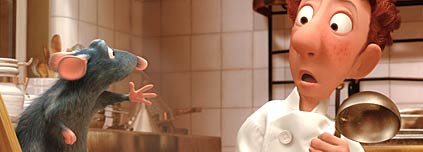

Welcome to Pixar studios, home of Woody and Marlin, John Lasseter and Brad Bird; birthplace of animated classics such as Toy Story, The Incredibles and now Ratatouille.
Watch an exclusive clip:
 Windows Media
slow . medium . fast
 RealPlayer
slow . medium . fast
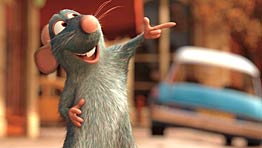
The walls here are adorned with artwork showing Ratatouille's hero Remy, a rat with a heightened sense of smell, who teams up with a bumbling garbage boy 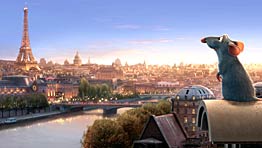 to realise his dream of working in chef Gusteau's Paris restaurant. But with the kitchen's bullish head chef on their case and a dastardly food critic ready to stick the knife in, the pair have their work cut out keeping their partnership a secret.
The ingredients might sound perfect for another Pixar tour-de-force, but assembling them isn't always that easy...
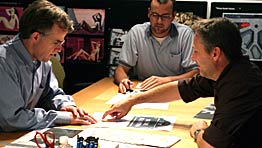
First comes the idea - re-assembled by Brad (The Incredibles) Bird from Jay Pinklava's original. Then there's the process of devising characters, writing the script and deciding on locations, before liaising with story supervisors and artists who start to visualise the film.
"Our goal is to get to what's in Brad's head and then hopefully along the way add embellishments to it that he may not have thought of," explains Ted Mathot, story artist.
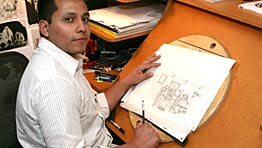
"We've done about 20,000 drawings since Brad came onto the film," adds Mark Andrews, story supervisor. "And that's finished drawings - the one's Brad liked and thought worked. We probably do ten drawings for every one [that works] on average - so, 200,000 drawings, or a cool half a million [for the entire film]. We're constantly, constantly drawing."
From storyboarding, it's on to Jason Deamer and Brian Green (character designer and supervisor, respectively) who slowly bring Remy and co to life.
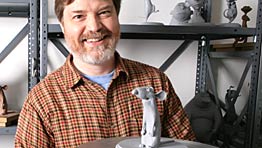
"One of the first things we do when we design the characters is to go to real life," explains Deamer. "On this film, we took four or five trips to Paris to visit restaurants, we also looked at people we knew to reflect the characters, and the director also had artists that inspired him.
"We'll take all of those ingredients and start drawing like crazy. We'll do that until we home in on what the director feels is the best personality."
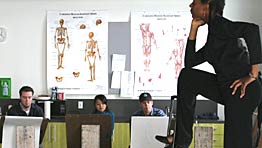
After that, they'll push the ensuing models and computer drawings to the limit, testing them for every facial stretch and smile wrinkle so that they won't break when called into action.
Production designer Harley Jessup then builds the sets for camera operator Robert Anderson to shoot and the process moves forward little by little.
"We're working for a year and a half developing the look before any production is started," explains Jessup. "Every item in the film has to be designed and built. Every thing you see on the screen we drew a plan for. It's almost like designing a live action movie where plans need to be drawn for all the sets; it's just in this case we can't go out and buy anything from the store so everything is built on the computers."
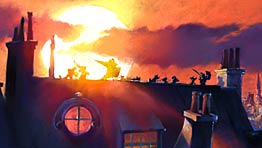
And the work just doesn't stop. Director of Photography Robert Anderson must ensure the cameras are positioned just right, Sharon Calahan works on capturing the perfect light and Apurva Shah devises the effects. It's very much a team effort (did we mention that every Pixar employee, from chef to security guard, is encouraged to learn how to paint or draw at Pixar University?).
Shah, for his part, explained the importance of getting the scale right and, of course, the cooking too!
"An example of scale is a sequence where Remy falls into a sink of water. From a rat's perspective, it's almost like a human falling into a pool from much higher up. We wanted to keep it at human scale but make it feel like what a rat would feel like. The speed at which things move and the details are all on a human scale but they have an imposing character of something much bigger.
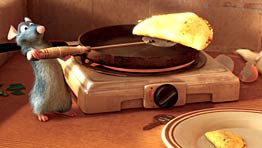
"And the other big challenge was cooking; you generally don't think of cooking and effects going together. But if you analyse it there's a lot of complex technical things going on and you're working with a lot of materials. Typically in computer graphics people deal with liquid - oceans and storms - or with solids and things blowing up or falling apart. But in cooking there are very many different kinds of materials that have a halfway quality of solids and liquids.
"When you work with batter and you're whisking it, that's very different from a more running fluid. Even something like cracking an egg... it was important to capture that in order to make the cooking feel believable."
"We spent a lot of time early on thinking about food and looking at photography, trying to analyse what made it look healthy and appealing and, in turn, what new tools and processes we needed to develop in order to do that," explains Calahan. "Apurva was wonderful in helping us to develop this new technology to make soft but accurate reflections and to make [the food] appear translucent."
Needless to say, every challenge was met and Ratatouille became another masterpiece for audiences to savour. The stresses and strains gave way to smiles and backslapping as thoughts turned to the next movie and how they might surpass their own achievements.
Written byRob Carnevale
Ratatouille is out on the 12th October 2007.