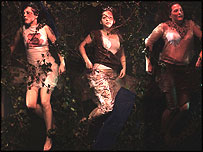
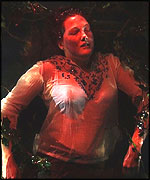
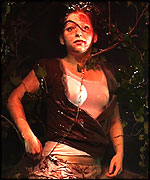
| The Lowdown... | The UK premiere of Raining Old Women And Sticks takes place at Theatre At the Mill on Tuesday February 7th and there are also performances on February 8th and 9th before the production continues its tour in North Wales. Box Office: 01274 233200. |
"Imagine... It's twenty years in the future, 2026. The UK is involved in an endless on-off war with Middle Eastern states. Here, security is tight and everything that is said may be heard, everything that is done may be filmed. Britain has begun to disintegrate under its own contradictions and the borders being closed down..." Yet this new play, created on the basis of interviews carried out in Bradford and Gwynedd, is very much about now. Iain Bloomfield, the Theatre In The Mill's Artistic Director, says: "This play is home-grown, inspired by many cultures who live in Bradford and the perceptions the outside world has of this city. It explores what we mean when we use the term "British". This play challenges us, looking at what both divides and unites communities." The production aims to bring together different communities by weaving together both Welsh myths and Asian stories and the landscapes of Snowdonia and Bradford. The five Welsh and British Asian actors tell their tale with the help of music, video projections, masks and even food. Iain adds: "The play raises many questions; What does it mean to be non white and English? Does a sense of 'British-ness' exist? Historically, Britain has always been a multi-languaged island. Raining Old Women And Sticks delves into language as a cultural reference point and asks, 'If certain words are untranslatable from one language to another, are thoughts? And if we lose our mother tongue do we also lose a way of thinking?'"  |
We asked writer Adam Strickson where the idea for the drama originated. He explains: "The idea came from Ian Rowlands, artistic director of Llwyfan Gogledd Cymru [North Wales Stage] and Iain Bloomfield who thought it might be worth looking at what young people of an Asian background and young Welsh speakers from Caernarfon and the rural area around it had in common, particularly in relation to language. Lots of interviews were done in Wales and Bradford. But the piece is not a documentary - it is a revenge tragedy where the personal and the political become intertwined, with grim results. It's partially influenced by the Welsh stories in the Mabinogion so it has something of the dark winter story about it." | "Our common bonds of humanity are clear and overwhelming. " | | Iain Bloomfield, Theatre In The Mill |
Buy why 2026? Adam says: "Setting it in the future allows us to push it into a more extreme dimension to explore current issues, for example Wales being used to provide electricity via nuclear power for England, employment, identity, changes in gender roles. This all sounds quite serious and it is!
"There are lots of hands in it so it's no one person's vision of the future. Really, it's to make people think about who they are and where they are going. In a UK context, I would say the North Wales Welsh speakers are rather more marginalised than people of a Mirpuri background in Bradford in their 20s who are very much operating within mainstream society, though not always happy to be there and sometimes unsure about where they are heading. I always feel a fragility in race relations in Bradford, though I strive to be optimistic. 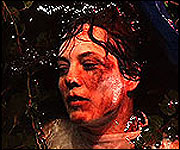 |
"It's just one vision of the future and not a particularly optimistic one. I think everyone involved in the project has a different view of the future. I suppose my view is that if we face up to some of the issues raised in the play, then the future will be brighter than that portrayed. Think of it as a 'lab' which explores the future." Adam thinks this might well be the first production to use different languages in this way: "As far as I know, nothing quite like this has been done. It's a very collaborative project. I don't speak any Welsh so Gwyneth Glyn has translated and written sections in Welsh. She's a Welsh singer and playwright. Yunis Alam from the University of Leeds has worked on sharpening the reality to one of the two Mirpuri characters - but I'm to blame for an awful lot of it! I think it will be very good, though it's been more than a challenge to do!" Iain too has faith in the production: "Throughout the making of this play, it is has been clear from our actors, writers and directors - of Welsh and British Asian origin - how language and culture are central to a sense of identity, and this place in which we live has always been a multi-cultural or multi-language environment. "An audience may not understand every word spoken but they will understand and identify every action and emotion. In this lies a truth. That which divides us - ethnicity, colour, language, religion, politics is quickly and easily apparent but it only take the shortest of looks beyond that and our common bonds of humanity are clear and overwhelming." |