


Broadband Britain - Journey's End
- 6 Jun 08, 16:30 GMT
We've travelled a thousand miles by air, road, and rail - and by Billy Mackenzie's boat across the loch from Arnisdale. We have been entertained in homes, student rooms and offices, and hooked ourselves up to broadband everywhere from a Scottish hillside, to a speeding train, to a shopping precinct in Milton Keynes.
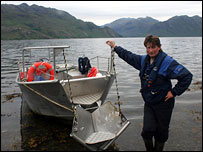 So what have we learned from our broadband journey this week? First, that there really is a digital divide between town and country, with rural broadband users typically getting a slower connection. And don't expect country dwellers to be any more phlegmatic about an inferior broadband service than they are about the closure of the local post office. After 36 hours without broadband or a mobile phone connection in Arnisdale, I was tearing my hair out (not a very time-consuming activity) so I can sympathise with anyone who is trying to work from home in those circumstances.
We've learned that mobile broadband is really taking off enabling you to get online just about anywhere - but its providers risk falling into the same bad habits as the fixed line companies who tantalise us with promises of speeds that can never be achieved.
It's become clear that the broadband industry needs to find a better way of measuring and explaining line speeds to its customers. We ran a crude but simple test on the site, downloading a 10mb video file wherever we went. For the record, the fastest time achieved was about 2 seconds on Dundee University's fibre network, though the Virgin Media 50Mbps home we visited was a more typical environment and there it took just over five seconds. The slowest was at our hotel in Glenelg, with a time of 4 minutes and 10 seconds...though one of the mobile dongles gave up without ever completing the download.
Some firms seem to think that broadband speed is only an issue for a minority of geeks. Well guess which subject has attracted more comment on the BBC's website than any other in its history? Over 60,000 people came and shared their experiences this week, more than twice as many as on the previous hottest topic.
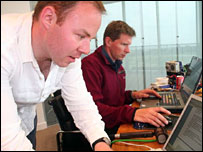 And I've learned more about what can be achieved by a small well-focused team prepared to try the latest technology to get on air. Usually when I go live on television, a large satellite truck rolls up, a dish is pointed at the sky - and we're on air very quickly, at some considerable expense. But this week we have gone live from every location simply by plugging into a broadband connection. It has been very hairy at times, we've fallen off air when a computer crashed, but it has usually worked - and the BBC has saved a sizeable four figure sum as a result.
And all that has been thanks to Neil Drake, the cameraman, editor and engineering wizard who has got us on air, and to Jonathan Sumberg, the immensely creative producer who has held everything together, surviving on about three hours sleep a night, and only occasionally favouring me with a frank assessment of my performance and dress sense.
Fibre, copper and aluminium
- 6 Jun 08, 10:30 GMT
I've been travelling around Broadband Britain with a whole lot of clutter in my suitcase - three phones, two computers, an SLR camera, three USB mobile broadband dongles, a digital radio recorder and two microphones. But buried in my bag are two lengths of cable - one traditional twisted pair copper telephone wire and one fibre-optic cable,
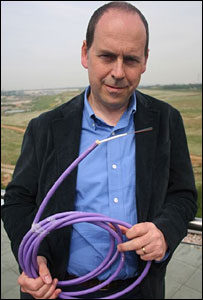 I've brought them along as visual props for my television pieces. TV is a very literal business and with something like broadband there are few pictures to convey the transition from a network based on copper, which is nearing its speed limits, and one based on putting fibre right into the home.
Mind you, last night when we visited a home where they were trialling Virgin Media's "up to 50Mbps" broadband, I was surprised to find that souping up the cable network to more than twice its current speed did not involve putting fibre into the home. The last link is still a coaxial cable with copper at the core - it's a new standard called DOCSIS 3 - digital over cable apparently - which is making everything go a lot faster. So maybe copper isn't finished yet.
In order to see this content you need to have both Javascript enabled and Flash installed. Visit BBC Webwise for full instructions
What I didn't pack was any aluminium cable, which would have been useful in Milton Keynes yesterday. The city's telephone network, built in the seventies when the price of copper was sky-high, has an awful lot of aluminium in it, which makes it pretty useless in terms of delivering broadband.
So Milton Keynes, a new town, is trapped in the 20th Century when it comes to the high-speed internet - which is why the fixed Wimax network we were there to cover is an attractive option for some residents with no other way of getting broadband.
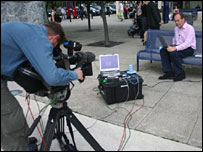 We used the Wimax network to do a live broadcast - which we thought might be a world first until we discovered that my colleague Alistair Leithead had broadcast live from Afghanistan via a Wimax network set up in Kabul. For developing countries with shaky fixed-line telephone networks Wimax is quite a useful way of getting broadband. How amusing that this applies to Milton Keynes too. Perhaps the city would like to twin with Kabul?
The BBC is not responsible for the content of external internet sites
This is dot.life - a blog about technology from BBC News.
Rory Cellan-Jones is the BBC's technology correspondent.
Maggie Shiels is the BBC's tech reporter based in Silicon Valley.
Archive
« January 2010
| Sun | Mon | Tue | Wed | Thu | Fri | Sat |
|---|---|---|---|---|---|---|
| 1 | 2 | |||||
| 3 | 4 | 5 | 6 | 7 | 8 | 9 |
| 10 | 11 | 12 | 13 | 14 | 15 | 16 |
| 17 | 18 | 19 | 20 | 21 | 22 | 23 |
| 24 | 25 | 26 | 27 | 28 |
Being Discussed Now
- Logging out... and straight back in(3)
- Gadgets of the Noughties(20)
- Plastic Logic's long journey to Vegas(21)
- Sexting teens(17)
- Wikipedia on the wane?(49)
- 'Cooling-off' for mobile phones? Not on the High Street(37)
- 2009 - the social year(36)
- Twitter, Iran and #uksnow(25)
- Broadband Britain - how far down the league?(55)
- Microsoft and Murdoch: Teaming up to bash Google?(34)
BBC Technology Headlines
- %28none%29
%28none%29 - %28none%29
%28none%29 - %28none%29
%28none%29
Visit the Technology index
Visit the BBC News website
Rory's TV/Radio reports
- Residents block Google car
Broadcast: 3 April 2009 - New adverts to tackle film piracy
Broadcast: 2 April 2009 - Call to scrap 'illegal databases'
Broadcast: 23 March 2009 - Female robot takes to the catwalk
Broadcast: 16 March 2009 - Super-charged battery breakthrough
Broadcast: 12 March 2009

- News Editors
- Sport Editors
- Journalism Labs
- BBC Internet Blog
- Radio 4 Blog
- Peston's Picks
- Nick Robinson's Newslog
- Stephanomics
- Mark Easton's UK
- Mark Mardell's America
- Nick Bryant's Australia
- Andrew Harding on Africa
- Gavin Hewitt's Europe
- Soutik Biswas' India
- dot.Rory
- Science: Jonathan Amos
- Richard Black on environment
- Today: Tom Feilden
- Fergus Walsh's medical files
- Newsnight: Paul Mason
- Newsnight: Mark Urban
- Torin Douglas
- Will Gompertz's arts
- Phil Coomes on photojournalism
- Magazine Monitor
- Mark D'Arcy in Westminster
- NI: Mark Devenport
- Scotland: Brian Taylor
- Scotland: Douglas Fraser
- Wales: Betsan Powys
- Martin Rosenbaum on FOI
- 5 Live Breakfast
- Newsnight
- PM programme (iPM)
- World Tonight: Robin Lustig
