


What future for OLPC?
- 1 Jan 08, 20:35 GMT
Mary Lou Jepsen, the chief technology officer of the One Laptop Per Child program has stepped down to pursue commercial interests.
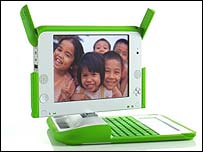
Jepsen's key role was to develop the laptop's power-efficient display and to ensure the computer was able to withstand the rigours of being used in difficult environments.
Her departure, coming at the end of the Give One Get One (G1G1) scheme which sold the laptop commercially to users in the US, will be seen by many observers as another piece of bad news for a project which has proved difficult to get off the ground.
Few at OLPC would argue that the scheme has yet to turn the idea of one laptop per child into actual laptops in the hands of millions of children.
Thousands of children now have access to the laptops but the success has been modest when compared to the original vision.
OLPC says the Give One Get One scheme has been a success and has seeded the launch of programs in Haiti, Rwanda, Ethiopia, Cambodia, Mongolia, and Afghanistan.
I've not seen any actual hard data for G1G1 sales - but they would make for interesting reading.
So does Jepsen's departure signal another setback for OLPC?
Clearly the design work for the current revision of the laptop has finished - so perhaps Jepsen's role had become somewhat diminished. But it does raise question marks about the long-term design evolution of the laptop.
The next 12 months will be crucial for the long-term success of the project. Nicholas Negroponte needs to turn interest in the scheme into hard sales, if his grand vision is to be realised.
He is due to speak at the Consumer Electronics Show in Las Vegas in the next week - and we'll be speaking with him and asking him about the future of the project, and the significance of Jepsen's departure.
The BBC is not responsible for the content of external internet sites
This is dot.life - a blog about technology from BBC News.
Rory Cellan-Jones is the BBC's technology correspondent.
Maggie Shiels is the BBC's tech reporter based in Silicon Valley.
Archive
« January 2010
| Sun | Mon | Tue | Wed | Thu | Fri | Sat |
|---|---|---|---|---|---|---|
| 1 | 2 | |||||
| 3 | 4 | 5 | 6 | 7 | 8 | 9 |
| 10 | 11 | 12 | 13 | 14 | 15 | 16 |
| 17 | 18 | 19 | 20 | 21 | 22 | 23 |
| 24 | 25 | 26 | 27 | 28 |
Being Discussed Now
- Logging out... and straight back in(3)
- Gadgets of the Noughties(20)
- Plastic Logic's long journey to Vegas(21)
- Sexting teens(17)
- Wikipedia on the wane?(49)
- 'Cooling-off' for mobile phones? Not on the High Street(37)
- 2009 - the social year(36)
- Twitter, Iran and #uksnow(25)
- Broadband Britain - how far down the league?(55)
- Microsoft and Murdoch: Teaming up to bash Google?(34)
BBC Technology Headlines
- %28none%29
%28none%29 - %28none%29
%28none%29 - %28none%29
%28none%29
Visit the Technology index
Visit the BBC News website
Rory's TV/Radio reports
- Residents block Google car
Broadcast: 3 April 2009 - New adverts to tackle film piracy
Broadcast: 2 April 2009 - Call to scrap 'illegal databases'
Broadcast: 23 March 2009 - Female robot takes to the catwalk
Broadcast: 16 March 2009 - Super-charged battery breakthrough
Broadcast: 12 March 2009

- News Editors
- Sport Editors
- Journalism Labs
- BBC Internet Blog
- Radio 4 Blog
- Peston's Picks
- Nick Robinson's Newslog
- Stephanomics
- Mark Easton's UK
- Mark Mardell's America
- Nick Bryant's Australia
- Andrew Harding on Africa
- Gavin Hewitt's Europe
- Soutik Biswas' India
- dot.Rory
- Science: Jonathan Amos
- Richard Black on environment
- Today: Tom Feilden
- Fergus Walsh's medical files
- Newsnight: Paul Mason
- Newsnight: Mark Urban
- Torin Douglas
- Will Gompertz's arts
- Phil Coomes on photojournalism
- Magazine Monitor
- Mark D'Arcy in Westminster
- NI: Mark Devenport
- Scotland: Brian Taylor
- Scotland: Douglas Fraser
- Wales: Betsan Powys
- Martin Rosenbaum on FOI
- 5 Live Breakfast
- Newsnight
- PM programme (iPM)
- World Tonight: Robin Lustig
