Many cities have a 'gay village' – an area with bars and clubs where LGBTQ+ people can feel safe to express their identity.
With Manchester Pride Festival taking place this August bank holiday weekend. Canal Street, which is recognised as one of the UK’s liveliest LGBTQ+ hubs, will be in the centre of the celebration.
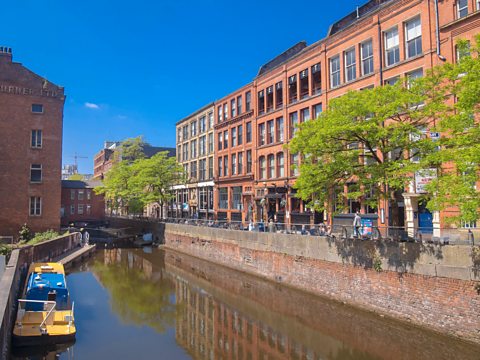
The beginnings of Canal Street
In the 19th Century, the area surrounding Canal Street was thriving – not with bars and clubs but with the cotton trade. Manchester had become Cottonopolis – at its peak producing 30% of the world's cotton. At the heart of Cottonopolis was the network of canals that kept the cotton trade moving through the city.
Booms are typically followed by bust, and when canals were replaced by other transport methods and the cotton industry stalled, the areas around the canals became deserted. This vacuum created a red light district, attracting sex workers and gay men to the area.
On the corner of Canal Street today stands a pub called the New Union. It was built in 1865, and in the 1950s became a place for lesbians and gay men to meet up.
It looks like a normal pub, but when you take a closer look you can see the windows are filled with clouded glass – anyone on the outside can’t see in. This meant that those in the bar wouldn’t be spotted by anyone walking past.
Decriminalisation and the raids
In 1967 homosexuality was partially decriminalised – gay men could have sex as long as it was in private, was only between two men and both were over 21. For many people it still didn’t feel safe to be openly homosexual, and for years there were still laws that could be used against LGBTQ+ Mancunians.
Long-time Manchester resident and LGBTQ+ campaigner Paul Fairweather recalls: “In 1978 the police raided Napoleon's under ancient by-law called Licentious Dancing, which prevented two men or two women dancing together and this clearly was an attempt to get the club shut down, which failed."
During the 1970s and 80s these raids continued: “From the mid-1980s the police used to regularly raid Clone Zone. James Anderton, Chief Constable made a famous statement about gay men 'swirling in a cesspit of their own making'. It was clearly very, very hostile to lesbian and gay community,” says Paul.
Manchester’s first Pride and Manto
But despite that hostile environment from the police, the LGBTQ+ community in Manchester began to flourish, launching its first gay Pride in 1985. It started on a small scale – as a charity event for those with HIV and AIDS. Today it’s an internationally renowned event, attracting huge acts and thousands of visitors.
In 1990 there was another turning point: the opening of a club called Manto. With huge glass windows, you went there to be seen, not to hide.
Club manager Steph was there from the opening night: “Manto was an absolute game changer. Manto was the first venue that was visible.”
Canal Street goes Mainstream
By the end of the 90s Canal Street had grown and was ready for the mainstream. On 23 February 1999, three and a half million people tuned into Channel 4 to watch Queer as Folk. The series showed Canal Street to be full of great parties and an amazing atmosphere.
The success of the series made Canal Street internationally famous, and it meant that Canal Street now wasn’t just popular with an LGBTQ+ crowd. This was great for the businesses on the street, but for some it meant that the street lost some of its identity.
What some would argue was Canal Street’s loss is the rest of Manchester’s gain. As the new Millennium progressed, it became more normal for the bars and clubs of the city to fill with visitors who feel able to hold hands, find a partner, kiss, be themselves – something that they were once only able to do on Canal Street.
Canal Street is still a popular destination today and continues to be somewhere for LGBTQ+ people to feel safe and express themselves.
You can hear the full story in this episode of In This Place: Gaychester.

It is always good to speak to someone you trust about the issues you might be facing, no matter how big or small. It can be hard talking about gender, sexuality and relationships.
If you or someone you know is struggling with issues raised by this story, you can find support through the BBC Action Line.
Published in February 2021, updated in August 2025
What’s Manchester got to do with the iconic BAFTA mask?
The BAFTA mask is one of the most iconic trophies in the world - read all about its history here.