


 | |
Front Page | |
World | |
UK | |
UK Politics | |
Business | |
Sci/Tech | |
Health | |
Education | |
Sport | |
Entertainment | |
Talking Point | |
In Depth | |
On Air | |
Archive | |
| |
| |
| |
| Feedback Low Graphics Help | |
Thursday, July 29, 1999 Published at 08:56 GMT 09:56 UK

Sci/Tech
Government warns of eclipse danger

Beware of sub-standard "mylar" filters
 | |
 | |
 | |
 | |
 | |
 | |
| |
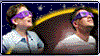
Chief medical officer at the Department of Health, Professor Liam Donaldson, has issued official guidelines telling people not to look at the sun directly on 11 August.
 | |
| BBC Science Correspondent Pallab Ghosh reports |
"It can affect everyone, particularly children, so I would urge great caution."
The eclipse event will last two and a half hours in full, although the total eclipse, when the moon completely covers the sun, will be over quickly.
![[ image: It is even more dangerous to use a telescope]](/olmedia/405000/images/_405720_telescope150.jpg) |
| It is even more dangerous to use a telescope |
The Royal National Institute for the Blind says people have damaged their vision by looking at the sun for as little as five seconds.
The government warns using binoculars or telescopes will increase the risk of eye damage, and advises against taking photographs of the event.
The DoH is also urging caution for those using specially made solar viewer glasses, or "mylar" filters.
![[ image: How to use a pinhole camera]](/olmedia/405000/images/_405720_pinhole150.jpg) |
| How to use a pinhole camera |
Professor Donaldson suggests using a home-made pinhole projector, projecting the eclipse on to a screen for viewing.
A pinhole projector is made from two pieces of cardboard, one of which has a pin-sized hole in it. The card with the pinhole is used to cast the image of the sun on onto the second card.
![[ image: ]](/olmedia/405000/images/_405796_pinhole2_fctbx.gif) |
Weather forecasters have predicted the eclipse could be affected by cloud, but Prof Donaldson said poor weather did not necessarily lessen the danger.
"I still don't think it would be safe - you never know when the sun is going to pop out from behind the clouds," he said.
"So we would say, enjoy the atmosphere, enjoy the eclipse but don't take any chances."
 | |


Sci/Tech Contents

| Internet Links |
| Eclipse 1999 - BBC News Online |
| The BBC is not responsible for the content of external internet sites. |
